
What's Coming Up?

Tom O'Grady takes you on a tour of what's interesting to see in the night sky, with an occasional comment about the daytime sky. Check back from time to time to see
'What's Coming Up'.
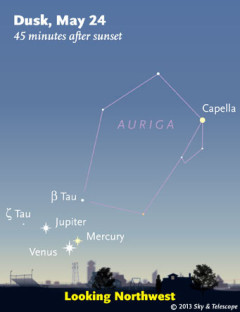 From Sky and Telescope
Saturn and Venus Replace Jupiter for the Summer
(5/10/2013)
Jupiter has been a splendid addition to the evening skies for several months. We lapped it in our orbit around the Sun a while back and are now (mid-May) on the far side of the Sun ready to put it between us and the giant planet. Jupiter is now setting in the west before twilight is finished. Jupiter will join the planet Venus and Mercury for a few evenings after twilight and then will be lost to the evening sky for a few months. Don't miss this gathering of the celestial royalty in the western twilight toward the end of May.
Jupiter will next be visible low in the eastern sky before sunrise beginning in mid-July. You’ll have to rise early to be rising with Jupiter.
Venus left the morning sky early this winter and has been working its way around the far side of the Sun. It will now start to appear low in the western skies at twilight. Passing through that section of the Zodiac where it is headed this year it will remain rather low and relatively close to the sunset. It should be somewhat higher and brighter by the winter holidays but will be worth watchinglooking for in the fading twilight through summer and autumn.
Saturn, however, is front and center for the summer. Having spent the past few years trudging its way through the constellation of Virgo, Saturn is now gracing the region of Libra, the Scales. The best way to find Saturn these days is to star hop your way to it. Find the Big Dipper. Follow the arc of the Dipper’s handle to Arcturus. Continue along that arc until you come to Spica in Virgo. Spica is quite bright. As you are looking at Spica, notice the bright object to its left, or east. That is the ringed planet. It has a yellow hue to it compared to Spica. That is sunlight bouncing off of the cloud tops and rings of that heavenly orb.
Saturn resides by itself in a rather dark and empty part of the sky between Spica and the not-so-bright, not-so-square box of stars that account for the constellation of Libra, the Scales. The two leading stars are brighter and closer together than the trailing two stars that make up this rather unimpressive polygon occupying the space for Libra along the Zodiac. These two stars have a long and interesting history to go along with their long and interesting names, Zubenelgenubi and Zubeneshcamali.
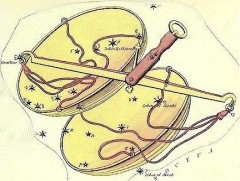 Scales of Libra - from Wikipedia
Saturn Bridges Virgo and Libra This Summer
Libra is not one of the outstanding star groupings along the Zodiac. A sight easier to find than Cancer and Pisces maybe, but it lacks something in its presentation. However, one can spend a bit of time considering some of the stars and their relations with this and the other nearby constellations.
Saturn draws some attention to the two stars to its east, Zubenelgenubi and Zubeneschamali. There’s a mouthful. The names are derived from the Arab language, as are the names of so many stars. Zubenelgenubi means claw of the north and Zubeneschamali means claw of the south. It is presumed that these names refer to the claws associated with Scorpius. References to that celestial arthropod with the venomous stinger go back to the time of the Babylonians. These two stars hold the place of these claws reaching out toward Virgo.
Apparently the Greeks and Romans separated this part of Scorpius into the constellation of Libra, the Scales, possibly because the Sun shown in front of these stars at the time of the autumn equinox over 2000 years ago. The balance of the scales may symbolize the equal lengths of day and night that attend the time of the equinox.
Because of the Earth’s wobble, precession has put the Sun in front of the stars of Virgo at the time of the autumn equinox in the modern era. Babylonians, Greeks and Romans all associated Virgo with wheat, agriculture, or fertility. She is often depicted holding a sheaf of wheat or some form of grain represented by the bright star, Spica. The name Spica derives from the Latin spīca virginis "Virgo's ear of grain" (usually wheat). A blue giant shining with a luminosity some 2300 times that of the Sun, the 17th century German astronomer Bayer and others of that period referred to the star as Arista.
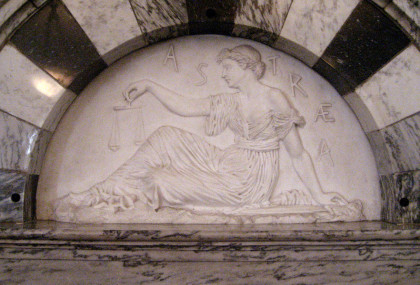 An 1886 bas-relief figure of Astraea (or Virgo) holding the scales in the Old Supreme Court Chamber at the Vermont State House. Wiki
While Virgo has regularly been associated with the harvest, according to some Greek mythology, Virgo represents Astrea, a Greek goddess of justice, holding Libra the Scales. Blind Justice holding the scales stands atop many a courthouse in America today. Might it have a connection to the stars in the night sky? Astraea’s nativity seems a bit confusing. Some sources put her as the daughter of Zeus and Themis, another goddess often associated with justice. Astraea is also called the daughter of Astraeus and Eos (Dusk and Dawn).
 Themis - Lady Justice with scales and sword in front of public building. Wiki
Astraea, star-maiden, and her mother were both personifications of justice, though Astraea was also associated with innocence and purity, like the dawn. She is always associated with the Greek goddess of justice, Dike. Astraea, the daughter of the father of the stars, Astraeus, wears a couple of different hats in the night sky being associated with both the harvest and justice.
Who said that mythology or the night sky were simple? Sort it out for yourself. Spend a little time this summer contemplating the skies around Saturn, the god of the harvest, sometimes characterized as Father Time wielding the harvesting scythe. This, because during antiquity his Greek name Cronus was often interpreted as Chronos, the personification of Time.
 Saturn Cutting Off the Wings of Cupid 1882 by Ivan Akimov. Wiki
A somewhat troubling character in mythology he is sometimes depicted eating his children and other times cutting off the wings of Cupid with his scythe. How appropriate that time and space, equinox and harvest, Virgo and the scales of Libra and justice all surround Saturn and Zubenelgenubi and Zubenescamali for these long summer evenings. Gives us pause and something to think about.
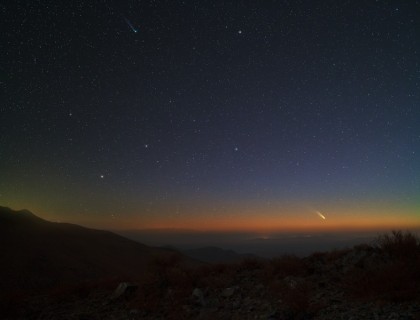 Comets Lemmon (upper left) and PanStarrs (lower right)
Comets on deck (3/2/2013)
2013 appears to be the year of the comets. Two comets are gracing the sky in the southern hemisphere as of early March. Comets Lemmon and Pan STARRS can both be seen in a common glance in the evening twilight a considerable distance south of Ohio.
However, prepare for the Ides of March. Around the 15th of the month Comet Pan STARRS may be visible in the twilight sky above and to the left of the waxing crescent Moon. It may be rather faint and will require a bit of effort to spot it, but therein lies the reward. Catching a fleeting glimpse of a temporary visitor to the inner solar system is a special event. Most people will not have the experience. Seeing an object that was not there before, is there now, and then gone shortly reminds us of the real action that is taking place in the cosmos.
But the best hope for cometary exuberance comes later in the year. After Thanksgiving in 2013 we are expected to be visited by a comet, the likes of which has not been seen since the 17th century. Comet ISON offers great promise at this point. The head of the comet is expected to be as bright as the Moon and could be visible in the daytime sky while the sun is shining brightly.
Comet enthusiasts have reason to restrain their expectations regarding comets. Pan STARRS had a bit greater build-up than it is likely to deliver this spring. Those waiting for years for a glimpse of Halley’s Comet in the 1980’s saw little more than a faint smudge to the naked eye and only a bit more through a telescope. Halley’s Comet didn’t present the kind of display in the sky which it had so many times in the past and as so many people had hoped. It wasn’t in the stars for the most recent lap around the sun to be one of the memorable passings.
Probably the biggest lesson learned by comet watchers was with Kohoutek in 1974. Lauded as the Christmas Comet, the Comet of the Century, and other overstated modifiers, it shined brighter as an artist’s rendition on the cover of Time Magazine than it did in the night sky. Passing by the sun at perihelion apparently evaporated much of the coma of this tailed visitor.
So, we will see what comets have in store for viewers in the northern hemisphere in 2013. Keep your fingers crossed for a good showing of these hairy stars.
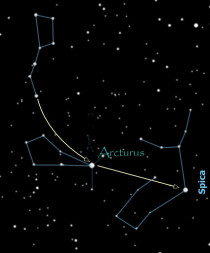 Follow the arc of the Dipper's handle to Arcturus and Spica
Arc to Arcturus
The Big Dipper is one of the most easily distinguishable asterisms in the night shy. From southeastern Ohio it should be visible every clear night from dusk until dawn. In the springtime it can be seen standing on its handle to the east or the right of the North Star.
As the evening progresses the bowl of the Dipper will work its way above Polaris and the handle will be seen to arc toward the eastern horizon. At some point one should be able to follow the arc of the Big Dipper’s handle toward the horizon and see the fourth brightest star in the night sky blinking through the colors of the spectrum as it rises above the eastern horizon. Arcturus is a red giant star about 36 light years distant from Earth. Arcturus is a commanding point of ruddy orange-yellow light when it is soaring through the night sky. It rises fairly far north along the eastern horizon and eventually swings directly overhead at these mid-latitudes of the northern hemisphere.
Arcturus holds a place at the base of a kite shaped pattern long known as Bootes the Herdsman. A goatherd to be exact. But the name Arcturus comes from the Greek signifying the guardian of the bear. Circling Ursa Minor as it does and following Ursa Major it seems to end up herding bears instead of goats. Being so well associated with the far north it appears to have leant its initial to the northern region of the planet above the Arctic Circle.
While you are following the arc to Arcturus you might continue along that same arc and a bit later in the evening it will take you to the rising location of the blue star, Spica, in Virgo the Virgin. Virgo is usually depicted in artistic renderings grasping a sheaf of wheat of a grain of some sort. Spica represents that seed head.
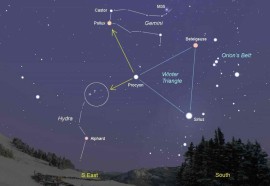
Exit the Summer Triangle
Enter the Winter Triangle
The Summer Triangle, the asterism made up of the brightest stars in Lyra, Cygnus and Aquila has commanded the largest part of the high center of the sky for months. Vega, in Lyra the Lyre, Deneb, in Cygnus the Swan, and Altair in Aquila the Eagle, have been mainstays in the night sky all night long for six months.
All of that is changing. The Summer Triangle is giving way to its winter counterpart. As you watch the stars of the Summer Triangle decline in the western sky, look to the east and see Betelgeuse rising. Betelgeuse, the red giant star in Orion the Hunter is the first of the three to rise in the east. It shows up on the horizon flashing through the colors of the spectrum. Betelgeuse is a good way off. Its distance is confusing astronomers. It has recently been increased from about 430 light years to around 600 light years distant from the Earth. It is thought to be about 15 times the mass of the Sun and about 600 times the diameter. It may be about 50,000 times brighter than our Sun. We can see Betelgeuse quite well from here but it is not likely our Sun can be seen from there.
As Orion rises higher above the eastern landscape, watch the spot along the horizon that the belt stars of Orion point toward. There will rise Sirius, the dog star, brightest star in Canis Major and the most luminous star in the night sky seen anywhere from the surface of the Earth. Now that star will twinkle and blaze with changing colors as it rises. It resembles a small traffic light constantly changing colors as it ascends above the horizon. Sirius is approximately eight light years away from Earth.
It is followed shortly, some distance northward along the eastern horizon by Procyon, the brighter of the two stars that make up the little pup called Canis Minor. Procyon means 'before the dog." That name is a relic from an earlier time when Procyon used to rise shortly before Sirius during the reign of the Pharoahs. Its rising signaled the soon to rise Sirius, a star of great import to the early Egyptians. Procyon is another neighbor of ours, relatively close at a little more than 11 light years distant.
Procyon completes the Winter Triangle. The most conspicuous difference between the two triangles is that the triangle of summer is a longer, narrower, acute triangle while that of winter appears equilateral.
The Winter Triangle does not tower overhead and pass near the zenith as does the triangle of the summer time. The Winter Triangle rises more to the southeast and passes over the meridian to the south and sets in the southwest.
While the Summer Triangle is home to a few other smaller and less significant constellations such as Sagitta the Arrow, Vulpecula the Fox, and nearby Delphinus the Dolphin, the Winter Triangle is home to the invisible unicorn known on star maps as Monocerus. If you want to see Monocerus - look at a star map. That's the only place you are likely to see it. Otherwise, look into the center of the Winter Triangle and, although you are not likely to see Monocerus, you will be staring right at it. Imaginations of the modern era may not be as robust as they were in earlier days. That or the skies are considerable more polluted with light.
When the Winter Triangle is aloft the brightest stars of the year are in the sky. Orion the Hunter with his two dogs are sparking a rabbit (Lepus the Hare) alongside the meandering river called Eridanus. Across the river Eridanus from Orion is the bull known as Taurus. Taurus is made op of the Hyades star cluster and the bright red giant Aldebaran and the nearby group of gals known as the Pleiades, the Seven Sisters, daughters of Atlas (the fellow they named the big book after which contains all of those maps). The Japanese call that star cluster Subaru.
Over the back of the little dog you can easily see the Gemini Twins sticking their feet in Orion's face. Gemini can be identified with the two bright stars that designate the heads of this pair of brothers, Castor and Pollux. Pollux is the brighter of the two but close investigation of Castor over the past few centuries has revealed that this sibling, while not brighter is rather sensational. It may look like a single star to the unaided eye, telescopes have discovered that this dimmer of the two is really made up of six stars - three binary systems orbiting a common center of gravity. Check that out in your mind's eye!!!
The Winter Triangle heralds the appearance of a a host of new targets for stargazers and they do not disappoint.
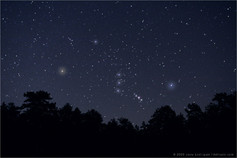
Orion - Like a Signpost in the Sky Points Westward to Taurus and The Pleiades and Eastward to Canis Major
In The Starsplitter, a poem about a fellow in Vermont who burned his house down for the insurance so he could buy a telescope about a hundred years ago, Robert Frost said ""You know Orion always comes up sideways. / Throwing a leg up over our fence of mountains,..."
Indeed he does.
Orion, rising in the east just after dark with bright red Betelgeause and Bellatrix is followed by Orion's belt stars. Note that the belt stars point upward away from the horizon and aim essentially at the stars of Taurus the Bull and The Pleiades.
Taurus is the V shaped group of stars coming up on its side - open to the north, with the bright red giant Aldebaran at the end of the lower arm of the V. That V shape is actually a star cluster called the Hyades. A small pair of binoculars will reveal a lot more stars in that grouping than meets the unaided eye. Jupiter is off to the left or north as you watch Taurus get higher in the eastern sky.
Back to Orion. Note that the belt stars are pointing directly down to the horizon. If you keep an eye on the horizon at the point where Orion's belt stars are pointing, at long last you will see a beacon rising and blinking throught the colors of the spectrum. That flashing light is the brightest star in the night sky as seen from Earth. It is known as Sirius, the dog star. It will not fail to rise exactly at the point where Orion's belt is pointing. Try it out for yourself and then show someone else.
Sirius is the brightest star in the Constellation of Canis Major, the great dog. This star has held the eye of man in devout admiration throughout all of human history. It played an important role in ancient Egypt. It is said that a shaft was built in the Great Pyramid at Giza with an opening to a crypt or room and that the bright star Sirius passed by that open shaft every day. Well, half the time in the daylight and half in the nighttime.
It is also said that the Egyptian high priests or starwatchers of the pharoah kept track of that brightest of stars and noted that when it rose in the eastern twilight sky, just before dawn, the heliacal rising of Sirius, they could predict the flooding of the Nile River in the next few weeks.
Predicting a flood in our part of the world takes no real talent. If it rains hard enough, long enough, the river is going to rise out of it's banks. Different story in the Egyptian desert. It doesn't rain there enough to cause a flood. The flood in the desert around Cairo, Egypt was caused by rains months earlier in the tropics far south in the headwaters of the Nile River, 30 degrees south of the pyramids, near the equator. Those rains swell the load in the Nile River and cause it to rise over its banks in the desert regions furhter north some months later.
Since this was an important event because it enriched the floodplain with nutrients and because it was important not to plant until after the flooding or the crops planted too soon would be lost. This gave the high priests or star watchers a certain amount of power back in the day. It allowed the pharoah to have some control over the harvest and therefore over the masses.
When Sirius is rising in the moments before dawn, it doesn't get very high above the eastern horizon before the Sun comes up. It moves across the sky from east to west just ahead of the Sun and sets just before sunset. This occurs during the month of August and this time of year is often referred to as the Dog days of Summer for this reason. The dog star is moving across the sky all day with the Sun. Dogging it, you might say.
In somewhat recent history certain researchers investigating the Dogon people, of Mali in West Africa, have reported that they seem to possess advanced astronomical knowledge, the nature and source of which have subsequently become embroiled in controversy. They reported that the Dogon believe that the brightest star in the sky, Sirius has two companion stars and that theyknew this long ago before it was first discovered by scientists. The jury is out on the facts here but it is not surprising the any group of tribal people on the planet Earth would have some keen interest in this brightest of all stars in the night sky.
Take some time and watch it rise. Watch it twinkle and run through the colors or the spectrum. It seems most dramatically colorful when it is closer to the horizon. It is bright but it still doesn't hold a candle to Jupiter which will be sharing the nighttime with Sirius this winter.
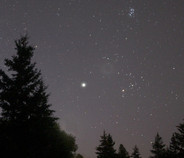
Jupiter Surrounded By Stars
Jupiter is rising in the east earlier each evening. It is well above the horizon by 10pm from Ohio. Look for the Pleiades in the east. Just below the Pleiades will be the Hyades, the V shaped satr cluster that gives its shape to Taurus the Bull. The V is lying on its side with the apex pointing south. The bright red star, Aldebaran tops off the lower arm of the V. Off to the north or left of the Hyades is the very bright Jupiter, king of the gods. Off to the north or left of Jupiter as it is coming up in the east is the constellation of Perseus the warrior, hero.
One of the brighter stars in Perseus is the star Algol, the demon star or the Eye of the Medusa. This star dims out every two and a half days for about four or five hours and then brightens again. This little detail didn't go unnoticed by the ancients. The questionable behavior, however, wasn't due to any nefarious activity undertaken by the mythological character, Medusa, but the regular eclipsing binary star system that makes up this varying point of light in the autumn skies.
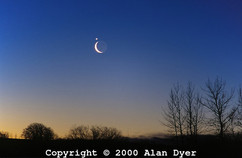
Venus to be Joined by the Crescent Moon in Predawn Sky
Maybe a Look at the Dark Side Too (of the Moon that is)
The goddess of love will rise in the east along side of the goddess of the hunt before sunrise in a couple of weeks. It should be a fairly close passing of the waning crescent moon and the morning star in mid November.
Not telling which morning is the closest approach. Get up and start looking at the predawn happenings now! Watch the drama unfold. It's not the single event that's cool. It's the day to day changes leading up to the conjunction of these two brightest objects of the night sky. Anyway, it might be cloudy or raining that morning. Might be a blizzard. You never know. But, if you watched the approach for a few days ahead of time you can imagine the culmination of this event in your mind's eye. Not as good but a decent consolation prize if you've been attentive.
The waning crescent moon is always a delight to watch rise - even if it is all by itself. It more than doubles the pleasure when it is joined by Earth's sister planet in the morning twilight. And there is always the chance that if you make the effort you'll be treated to a glimpse of the dark side of the Moon as well.
A predawn amusement is gazing upon that dimly lit, gibbous-shaped, almost transparent looking, dark side of our nearest neighbor. Glowing in a faint ashen-gray light, this side of the Moon is sometimes nearly the same color as the background sky. We can only see this phenomenon just before new moon in the morning sky and just after new moon in the twilight following sunset because of twice ricocheted sunlight.
While the sun is lighting up half of the Moon, most of which is facing away from Earth, the Sun is also lighting up half of our world. If one were standing on the dark side of the Moon looking up they would see a large gibbous shaped Earth. That huge body would be relecting sunlight off of the cloud tops, polar caps and oceans. The reflected light would be shining down on the night side of the Moon and lighting it up brighter than the full Moon does the dark side of Earth. That 'earthshine' bounces back from the night side of the Moon and can be seen with the unaided eye from the surface of the Earth. From Sun to Earth to Moon and back to Earth so we can ponder and gaze upon the nightime of another world.
All of this while you are having your coffee before work. Oh, yeah - start watching for Mercury and Saturn rising is the east before sunup - while you're up.
Saturn Joins Venus in the Pre-Dawn Sky
Saturn spent a good part of the summer dancing with Mars and Spica in Virgo in the western skies after sunset. We here on Earth slipped past the Sun putting Saturn behind it for the past month or so. Now Saturn emerges in the morning sky, rather dimly for starters. As the month moves along we will see the distance between Saturn and superbright Venus decrease with the passing days. The pair will find themselves less than a degree apart in the morning sky on November 26. And remember, in Greek mythology, whenever the gods and goddesses are getting together they are often up to no good as far as us mere mortals are concerned. Keep and eye on them. It's worth checking out as they get closer each day and then pass on their merry ways.
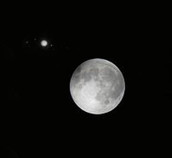
November Offers a Couple of Close-by Visits Between Jupiter
and the Moon
Now that Jupiter is entering our evening sky at a reasonable hour we will have more opportunities to watch it rise and cross the sky in the company of Aldebaran and the Hyades of Taurus the Bull. With the Pleiades nearby and Perseus not far off to the north this is a busy and bright section of the sky. The
Moon will pass by Jupiter around the 1st of November and then again, with an even closer grazing on or about the 28th of the month. In some places around the world the Moon will occult the king of the gods, blocking out the third brightest object in the night sky. We won't get to see that however.
Nevertheless, November offers some very starry skies after a couple of months of star patterns without too many bright stars or dense groupings of such.
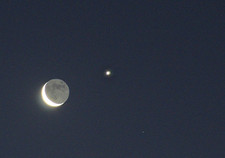
Venus is Scheduled to Rendezvous with the Waning Crescent Moon Before Dawn in Mid October Always Worth a Look-see
Venus is dazzling every morning, high in the east, before the sun comes up. Also a good time to look for the dark side of the Moon. No doubt the album is right where you left it but in this case we are looking for the side of the Moon visible in a faint ashen gray light illuminated by twice ricocheted sunlight. The Sun shines on the Earth and light bounces off the oceans, cloud tops and polar caps and is reflected down onto the dark side of the Moon. It then bounces back toward Earth allowing us to see the faintly lit dark side. Some refer to this as the old Moon in the new Moon's arms. Awww!
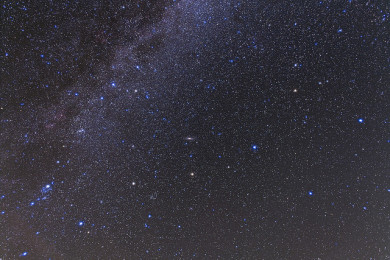 Pegasus, Andromeda, Perseus and Winter Milky Way
Solar System Display Gives Way to
Brighter Stars and Cooler Nights:
Planets Head for Morning Skies
It has been a banner year thus far for stargazers. We had the opportunity to watch as Jupiter and Venus approached each other bit by bit over many nights last winter until they stood side by side in the western twilight in early March. The waxing crescent Moon joined them on occasion and we could gaze upon the three brightest objects in the night sky in their tight grouping in the west. Then they separated, more each evening, as Venus climbed higher above the setting sun and Jupiter slipped into its glare.
There was the great opportunity to anticipate observing the rarest predictable astronomical event with the transit of Venus. How exciting! The small disc of the nearest planet passing across the face of the Sun was seen by millions around the world. Under the heavy overcast skies of southeastern Ohio we had our best view of that event by watching closely in our mind’s eye.
We watched Mars dance with Spica and Regulus as it did its retrograde thing. And we have watched Mars approach Saturn slowly over the course of the summer until they shine together at closest approach in mid August. The two planets form a triangle with bright Spica and then morph into a straight line. A few days later the waxing crescent Moon joins them and makes an attractive clustering of bright objects in the early evening sky. Next we will watch them distance themselves as Saturn begins to decline in the west and Mars resists the westward pull and lingers longer in our evening sky. Saturn will fade in the glowing twilight and Mars will be persistent but faint in the southwest through the rest of 2012.
The solar system has put on quite an evening show but the action has moved to the morning skies with Venus and Jupiter dominating the eastern view on all mornings absent the waning crescent Moon. Saturn will soon join them.
But the season approaches when the display of planets is replaced with the dazzle of bright stars. Perseus and Cassiopeia are coming on stage. The Great Square of Pegasus the Winged Horse is a lead in for Andromeda, Cassiopeia’s daughter. The Pleiades and the Hyades of Taurus the Bull introduce a couple of dense clusters of starlight. Bright orange Aldebaran punctuates one of the arms of the v-shaped configuration of the bull.
The Great Square takes up a good bit of the sky but it is rather easy to find. It shares a star with Andromeda, a long curving v-shaped pattern that helps guide us to the most distant object visible to the unaided eye – the Andromeda Galaxy. Looking like no more than a faint point of light, it is the accumulated glow of two to four hundred billion stars that make up this nearest of all spiral galaxies. That dim glow of untold numbers of suns has been travelling at 186,000 miles per second for the past two and a half million years. Don’t miss the chance to catch a glimpse.
Orion the Hunter, probably the most identifiable constellation in the night sky will begin to throw a leg up over the hills of eastern Ohio in the early evenings of the latter part of autumn. He is soon followed by his two dogs and a rabbit, Lepus the Hare. Orion presents many things to the stargazer. Bright orange Betelgeuse marks his shoulder while bright blue Rigel represents a knee or foot. The three stars in the belt of Orion are very distinctive. They point westward toward Aldebaran and the Hyades and Pleiades. They point eastward to the point on the horizon where the brightest star in all of the night sky can be expected to soon rise.
Sirius, the Dog Star, in Canis Major and Procyon, the brighter of the two stars of Canis Minor join Betelgeuse to form the Winter Triangle which can be seen rising in the east as the east of the stars of the Summer Triangle vanish in the west.
The elongated glow of the summer Milky Way will disappear with the Summer Triangle only to be replaced with a stretch of the winter Milky Way reaching through Cassiopeia, Perseus and Auriga, the Charioteer with bright yellow Capella marking one of its five corner stars.
While the bright objects of the solar system relinquish their places in the night sky we can anticipate more evenings filled with brighter stars than we have seen for months. The show never ends, it is just constantly changing.
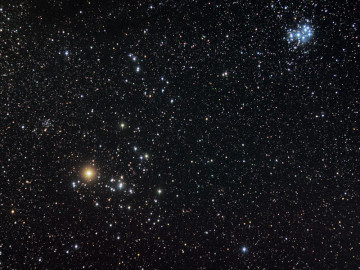 The Hyades with Aldebaran and the Pleiades
Athens Clear Sky Chart - sky conditions for Athens, Ohio

The Athens Clear Sky Chart is an astronomers forecast. It shows at a glance when, in the next 48 hours, we might expect clear and dark skies for Athens, Ohio. It's is specifically intended for amateur astronomers. Thanks to Attilla Danko for this widget.